|
The International Camellia Society [ TOPICS  ] [ Description ] [ Seedlings ] ] [ Description ] [ Seedlings ]
|
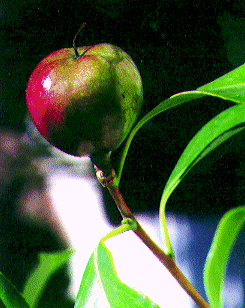
Camellia seedpots mature in autumn. Their sizes range from 1 to 5 cm in diameter, but in some species (C. crapnelliana) they may be as large as 20 cm. Their color is normally green or olive, but in japonicas, in the sun, they turn red like small apples (see).
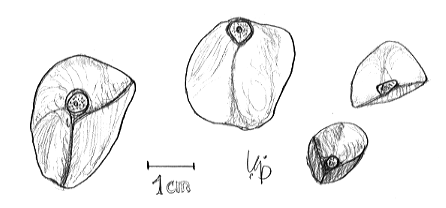
 A seedpot carries 3 to 12 seeds. When the pot naturally breaks, the seeds are mature and have a brown, hardy shell. Note that the seed sizes vary. Each seed has a distinct 'eye', where it was formerly affixed to the pod. It is near this eye, where the root will break through in the process of germination (see).
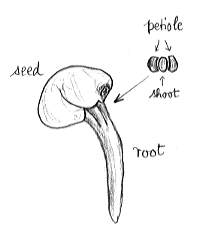
In camellias, the cotyledons will never leave the seed coat. After their job as nutrition depot, they dry and disconnect from the plant. The root develops first, and the following shoot will grow primarily into the seed. If you cut off the seed at this stage, you see three distinct structures (the shoot in the middle, and two petioles, or leafstalks), as indicated in the illustration to the left.
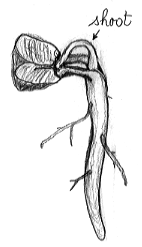 Later the shoot will bent and unfold as indicated in the right figure. Note that, at this stage, the shoot is very sensitive and must not be disturbed. It should be still underground. Transplanting the seedling now would damage the young shoot in many cases. The root is most vigorous and has a diameter of 3 to 5 mm. The shoot is usually smaller. When the shoot has bend and streched, it leaves the ground, and the small plantlet shows up above ground. Leaves are still unfold. At this stage it is time to cut the root tip. The reason is the following: camellias develop a tap root, up to a lenght of 20-30 cm. If bound to a pot, the root will curl at the bottom, and no good rootball develops. The cut forces the root to induce feeder roots. Sometimes the root is very smooth, in other cases there are some feeder roots from the start. In any case, the cut improves the situation for potbound plantlets.
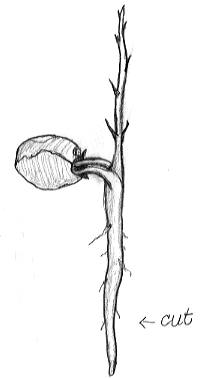 The left figure indicates a plantlet in unfolded stage, and where the root cut (2-5 cm below seed) is appropiate. I usually raise my seedlings in a plastic sieve 10 cm heigh, filled with peat and placed on top of a suitable small container. The seeds are covered about 2 cm with soil. As soon as the roots occur at the bottom, about 3-6 weeks after sowing, I cut them at the bottom of the sieve and leave the plants until they are in the unfolded stage. Then I transplant.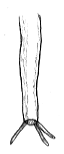
Some roots will not develop feeder roots, however, new roots will sprout at the cut (see figure at right).
Camellia seeds should be sowed immediately after harvest, their germinating capability declines if kept dry. During this process, the embryo shrinks and an air space inside the seed coat occurs. These seeds float in water and indicate reduced germination capability (however, some of them can still germinate). For storage, put fresh Camellia seeds into a plastic bag together with a moist paper towel, and keep it in the refridgerator at about 5°C. According to the people at Camellia Forest Nursery, the germinating power will sustain up to a year under this condition. Seeds of C. sinensis, however, decay more rapidly inspite of this procedure, they say. I got their seeds and found that C. japonica, oleifera and sasanqua had a germination success of 90% 10 month after harvest.
Please note that camellia plantlets at the unfolded stage are very interesting objects for experiments. They are very robust. For example, you can cut the petioles and use the seed as a medium to stick cuttings (J.C.Moore: Nurse Seed Grafting, in: David L. Feathers, editor: The Camellia, its history, Culture, Genetics and a look into its future development, The R.L. Bryan Company, Columbia, 1978. Note: I will try to get the right to post this article here. K.P.). The plantlet will grow easily without the further support of the cotyledons. I presently have a series where I graft a cutting directly into the root or into the shoot. See The Seedling Graft under Cultivation.
 Camellia: Seed and Seedlingsby Klaus Peper
|
| [ Home ] [ TOP ] |